These are bold statements from
http://www.mindresearch.net for what is essentially another raft of online games,
and we all know online games are abominable. They have not made many of their applets available to try for free, but what's there is definitely interesting (to check them out click
here and
here).
**UPDATE - Before posting this I decided to contact MINDResearch to give them a chance to comment. Not only did they reply, answering many of my fears about the shortfalls of these applets, but also
included a much better demonstration (here) of the way that progression between levels is handled.
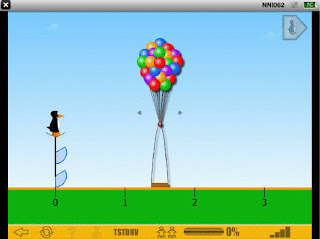 |
| Players must guess how far along the number line the fractions (here two thirds) will take them. |
Positives
- The emphasis here is definitely on making the maths intuitive using the information on the screen. This is a great first-step in comparison to the majority of online learning, where repetitive maths is tacked on to an existing (not very) fun game. The maths feels natural and even vital in this game world, whereas usually it is a chore to get through before you get to 'the fun bit'.
- The feeling of progression is the main/only motivating factor. In fact, the way that more difficult questions are linked to earlier questions is outstanding (It gave me huge pleasure to see the aliens start zapping some of your fractions to force you to find an equivalent)! Progression and 'acquiring new skills are intrinsic motivation and means your reward is the feeling that your maths is improving. Many studies have shown that intrinsic motivators such as this are more effective AND have fewer side-affects than the usual extrinsic (badges, etc.) motivators. (See 'Drive' by Dan Pink).
- Teaching is happening. There is a feedback loop on your initial guesses, showing what your guess means in this world. This is a great way to give pupils an idea of what the maths problem is really asking.
- It is a low-risk environment (no stigma for failure), so you feel free to try things out and lose a couple times. Allowing students to guess and try again can cause the problem of pupils gaming the system by spamming guesses until its right. These games get past that in two ways: you only have a few lives on each level, and the teacher is alerted to any student making too many mistakes so they can help with the misconception.
- This alert system, along with an 'ask for help' button, implicitly admits that this software will not be able to teach everyone and other interventions will be necessary. This is something that few other sites (in my experience) admit to.
- The fact that there are very few words will be a great boost to a huge range of pupils with EAL, dyslexia, etc.
- The game environment and interface is clean and doesn't include unnecessary distractions.
 |
1. Choose how to split the square (for the denominator)
2. Choose the numerator visually
3. Compare it to how much the aliens remove from the bridge |
Negatives
- The trade off with having a clean, uncluttered game environment (and sticking to progression as the only motivator) is that the puzzles can feel a little dry and samey. My guess is that this is not much of an issue for their core, primary school audience, but would have more of an effect with older pupils.
- Only one motivator; I like the fact that progression is the core motivator, but there are other intrinsic motivators that could have been employed as background motivation. I feel that this would help give a more rounded gaming experience. These could include feelings of mastery (on optional, extension levels or mixed question levels) and feelings of exploration (of the mathematical concepts, e.g. through sandbox style environments).
Conclusion
After trialling the fractions demo, I am very excited about this project, as I am in total agreement with a lot of their core principles. Unfortunately it is not yet available outside the U.S. and is more appropriate for a primary school.
Quotes from a MINDResearch representative
Indeed, our aim is to present math concepts in a simple, uncluttered way, so that students aren’t faced with distractions and they are able to purely focus on solving the puzzle. The feedback they receive is informative; the approach stems from neuroscience research involving the perception-action cycle, or rather learning by trial-and-error.
...our focus is to create intrinsic motivation instead of extrinsic motivation. The former compels students to challenge themselves because they enjoy the challenge, not because they will be rewarded with a badge, or prize (extrinsic motivation). Intrinsic motivation is much more powerful in the learning process...JiJi is the centerpiece of the puzzles, and you probably wouldn’t be surprised that students want to help JiJi get across the screen, so much so that they continue to persevere until they do
...Class-level and student-level [live] reports allow teachers to see which students are struggling (the report highlights a student who is “stuck,” and has tried a game/level a number of times) and thus intervene to help the student using questioning strategies or other intervention. The software also allows teachers to freeze the student’s screen, go back to the puzzle the student answered incorrectly, so that the teacher can pinpoint the exact issue that was causing the student to struggle.