Showing posts with label functional skills. Show all posts

Thursday, 12 December 2013

Improving Functional Skills in Mathematics

As mentioned in a previous post, I have been thinking lately about how to attack Functional Skills Mathematics to improve results. I have decided on a 4-pronged approach.

Prong 1 - Improving literacy in maths

I have already made a post with ideas and resources for this, which you can find by clicking here.


Prong 2 - Improving problem-solving skills

As functional skills is so focussed on long, involved questions. Students need to feel confortable deciding what steps they need to take and set out their work so that they can follow it and check for mistakes.
  • 3-Act Maths - I find this way of working to be an ideal way to introduce problem-solving to students in a non-threatening way. Starting with just the actual question and no constraints, variables or other information means that problems don't even look mathematical at first and students feel free to take guesses, make assumptions and bring in outside knowledge. Getting students to work out 'the information they would like in order to work out the answer' means that, when you bring those variables in, they are no longer confusing and unclear, but are now the very tools the students were asking for. I've used 3Acts from Dan Meyer's list, problems over at Finding Ways to Nguyen, and picture and video prompts from 101qs. I also sometimes just take a book question, skip all the set-up to the question and just ask the actual question (e.g. How long would it take me to cycle to Edinburgh? Can we get enough rain-water from the college roof to have toilets that run on the recycled water? etc.).
  • Structuring of workings out - e.g. using the problem scaffolder from the previous post on literacy. The idea of this is to help students to think clearly about the steps they are making and what they are trying to calculcate from each step.
  • Discussion of problem-solving strategies - I made some posters last year which I have up on the wall. Before tackling a problem I ask "which strategy could we use here? Why will that help?", when students are stuck I ask "which strategies have you tried? which might you try next?", when they finish I ask "which strategies did you use? did anybody use a different strategy?" Getting students to a point where they're comfortable with using these strategies and are starting to get a feel for when each one is applicable can only help their confidence when faced with a difficult problem.
  • Problem Posing - I originally got this idea from Matt Ives (blog post about it here). Basically the idea is to move focus away from getting the answer and move it on to thinking about the steps you would take and what information you would need. Matt Ives' way of achieving this: don't have any numbers, so pupils can't work out the answer, instead rewarding students who work out the steps they would hypothetically take to find the solution. He has a whole raft of them here on scribd and they've worked very well in the past, once students get away from trying to find an answer.

Prong 3 - Improving mathematical skills

  • Regular lessons - In amongst the literacy and problem-focused lessons, I will also include regular skills lessons. These will come before more complicated problems that involve these skills (along with others) so that students get to see them in context.
  • Starters and Homework - I will also include general basic skill revision in lesson starters and homeworks.
  • Fill in the blanks on calculation tables are a great way to make repetitive practice of a skill more interesting. I wrote a post about it here.

Prong 4 - Putting it together (and improving clear working)

  • Exam questions - The previous prongs will then be put in to practice when we do past-paper questions in class and for homework. I will link the problems to the work we have done on literacy and problem solving and discuss the skills that will be needed to solve the question.
  • 3-Act questions rewritten as past paper questions and vice-versa - After solving a 3-Act problem, I will show a version of how I think it would look like in an exam paper. Hopefully this should make students feel empowered that they've just solved such a difficult-looking question and will help them see the link between the problem-based lessons and the actual exams. After practicing an exam problem I will get students to try to imagine how it would look as a 3-act problem. Not only does this reinforce the link between the two, but help students decide which part is the question, the constraints, the variables, etc.
  • Peer marking - Will help students to see the importance of clear and methodical working as well as to think about different problem-solving strategies that others have used in their working.

Secret prong 5 - Improving Engagement

Overarching all of this is what I feel that I actually do best as a teacher, which is to show students that maths can be enjoyable and engaging. I achieve this in the following ways:
  • Improving accessibility - 3-Act maths are great for this, as are other rich tasks, and the fill-in-the-blanks calculation tables. This is because of the multiple entry points to the questions, and the lack of immediate reading and comprehension required. If students' literacy can be improved, then the more wordy questions will become less and less daunting.
  • Improving confidence - As students get more and more comfortable with multi-step problems they will see that there are things that they can achieve in maths. This never becomes obvious to students who only practice the basic, underlying skills, no matter how good they get at them.
  • Improving relevancy - By this I don't necessarily mean 'real' maths, but I mean maths that students can imagine themselves using in their lives. This is where are a focus on problem-solving strategies can be helpful, because even though the problem itself might not relate strongly to them, being able to use the strategies is applicable by anyone.
  • The strength of my sparkling personality? ...
  

Friday, 6 December 2013

Inspiring Mathematical Applications: Randall Munroe answers all

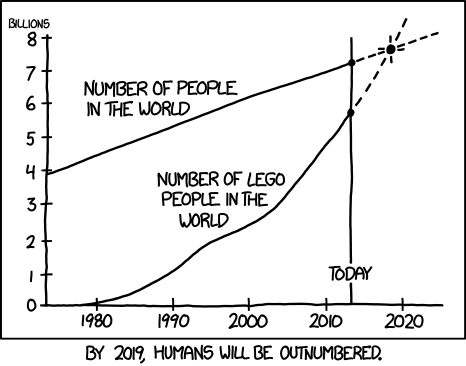
As a Maths teacher, I'm guessing you'll already be familiar with Randall's awesomely nerdy web-comic, xkcd:

Maybe you're also aware of his "What If?" site. If you're not, I'd like to introduce you to it. Each week Randall Munroe, a physicist and former NASA employee, answers question that people post to him online. Though the questions are usually strange ("How fast can you hit a speed bump while driving and live?") and sometimes ridiculous ("If you suddenly began rising steadily at one foot per second, how exactly would you die? Would you freeze or suffocate first? Or something else?"), Randall tries to answer them as accurately as he can, backing up his statements with citations and calculations.

Though, the maths sometimes gets quite complex, the funny topics and humourous pictures combine to make it much more approachable than it otherwise would be.

I love to read them just for myself, but I've also started bringing them in to some of my classes. Last week I found lots of ideas and resources for improving literacy in maths. This week, one of the ideas I tried was about scaffolding the problem, specifically splitting a question in to its important parts (The actual question, the information given, the constraints, what calculations are needed, etc.). As a plenary I asked them to guess the answer to, "Is it possible to build a jetpack using downward firing machine guns?", then to read through the What If? article about it, whilst highlighting the different components of the text (The question, the information gathered from research, the calculations, the constraints, etc.).

It worked very well, and the students really saw the link between the work they'd just done and the work done in the article. I'm hoping that this link will help them to feel empowered (because the techniques they are using work on much more complicated questions) rather than disenchanted by the complexity of the maths.

Tuesday, 3 December 2013

Improving Literacy in Maths

I've been thinking, lately, about how to improve literacy in Maths. If you would like to read the strategies I have so far come up with, skip to the first heading.

For the first time this year I am teaching Functional Skills Mathematics (Levels 1 and 2). The scheme of work I have for these classes is pretty bare-bones and is very skills-based. I am finding it hard to stick straight to the scheme of work, as most of these skills are actually more basic than what my students have already seen when attempting their GCSE and are made even simpler as there is no non-calculator test.

Historically, many students fail the level 2 course and when I asked my colleagues why, they all said that it was down to poor literacy skills. This is understandable when the questions all look like this:


Obviously literacy isn't the only difficulty with this question, so I have decided to teach Functional Skills with a four-pronged approach. I will go in to detail about the other prongs of my plan in a separate post... Prongs.


Prong one: Ways to Improve Literacy

1. Scaffolding questions and correct working

This can be done in different ways.
  • So far I have been getting them to write titles for each seperate part of their working before starting any calculations, so that they can then split the work in to more managable chunks.
  • In future I will try using a problem scafforlding sheet like this:
  • Problems with clue cards would also help to split up a question and promote discussion and team-work. It works like this: Each group gets a simple question. Each individual in the group also gets a different card with a single piece of information that is needed to answer the main question. Members of the group have to decide how to use and combine the information sheets they are given. Here is an example (For lots more, click here):
  • Question sequencing: All the correct working for a set of problems is written down on separate tabs of paper, but their order has been mixed up. Students must put the working in to a correct order.


2. Building vocabulary and making connections

This could include:
  • Word-walls: Where mathematical words can be written with their definitions and/or diagrams and grouped according to connections with other words.
  • Connect-two: You have a list of words at the top (eg. Percentage, fraction, TAX, Chocolate). You pick different pairs of them and explain in what way they are connected and give examples.
  • Word-splash: Similar to connect-two, but the words are on the board and you pick people to make a connection.
  • Anticipation guide: A table where the first column consists of statments and/or questions (eg. A decimal number is a number less than 1). The second and third columns give a space where students decide whether they think the statement is true or false and why. The second column gets their opinions before working on the subject and the third column gets it after working on the subject (good evidence of progression here too!).
  • Tarsias: These are jigsaws where students match a question to an answer (or a word to its definition). Mr Barton has loads available here. You could also print off a blank tarsia and get students to create one.
  • 3 facts and a fib: Students write down three facts and a lie about a maths object, word or topic. They try to make the lie believable enough that when they pass it to their neighbour, the neighbour can not work out which statement is the lie.
  • Definition map: to the example below I would add a space for illustrations of the word or concept:
  • Taboo: The classic game game be adapted easily to a nice plenary activity - give them a maths password (eg. Mutually-exclusive) and a list of taboo words that they are not allowed to use (eg. Probability, events, same time, both). The chosen student then has to describe the password, without using any taboo words, to the class until someone can guess it.
  • Pictionary: Similar to taboo except that you make drawings to represent the word.
  • The Mathematics Assessment Project has many matching activities designed to promote discussions and expose misconceptions, as well as Professional Development modules to help you use them effectively. Some of them are excellent.
  • Think, pair, share: Students work on their own on a question. In this time they may do some calculations but should focus more on organising the information and making notes. Next they get in to pairs. First they should take it in turns explaining their thoughts (one talker, one listener) so far, before working together to answer the question. Finally, they join another group and explain how they got to their answer (again taking it in turns so that both groups get to explain their work).
  • Odd one out: Take three different mathematical objects (eg. triangles) and get students to decide which is the odd one out, then discuss their decision with their partner. This works best if each object could be the odd one out for a different reason (isoceles, right-angled, different area, different perimeter, etc.). That way different students get a different answer and their discussions lead others to see the objects in another way.
  • Carroll diagrams: Two-way tables where students have to sort objects in to the correct section that matches the description of that word. Here is a good example.


3. Peer marking and constructive discussion

  • Marking each others' work will help them understand the improtance of clear working, with titles, explanations,etc. Discussing how a correct answer could be improved to make it more clear would also help with this.
  • Always, sometimes, never true: Students read a statement and decide whether it is always true, never true, or sometimes true. They then justify their answer and compare results with their peers (examples can be found here).
  • Rally coaching -  Students work in pairs. They take it in turns with one person answering a single question, whilst the other coaches. Coaching could simply be helping to solve the questions or could be more complex, with rules like, "avoid telling them what to do. Try to ask a question that will help them to figure out the next step."
  • Many of the activities from section 2 would also apply here.
  • Bowland Maths have a Professional Devolopment activity (module 3) described as "Fostering and Managing Collaborative Work: How can I get them to stop talking and start discussing?" I have not been able to look at this yet  as there is no sound on my computer at school, but I will update the page when I do. I have already enjoyed and would recommend some of the other PD modules on this site though.


4. Filtering information from text

  • Students highlight the different parts of a question in different colours (question, given figures, constraints, etc.)
  • Students write the gist of a block of text using only 20 words. Students could create an individual version, then a version in pairs, before writing a final one in their books.
  • There is a video series (click here) with worksheets (click here for the worksheets), where you are asked to fill in information as you hear it on the videos.


Credits

Much of these ideas (and plenty more ideas!) have come from:
  • "Growing the Connection Between Mathematics and Best-Practice Reading and Writing Strategies" by Jennifer Kosiak, Sue Schumann, Ann Harry and Bonnie Jancik (available here)
  • "WHAT’S LITERACY GOT TO DO WITH IT? Literacy in the Math and Science Classroom" by Blair Covino and Barb Mazzolini  (available here)
  • "Literacy in Maths" by The Highland Curriculum for Excellence (available here)
  • Other sources that have been linked above: Cumbria Grid for Learning, Mr Barton, Mathematics Assessment Project, Nrich, Bowland Maths and Channel 4 Learning.

Monday, 11 November 2013

How to create enagaging, functional maths problems in 2 minutes *UPDATED


Step 1: Take a table of calculations that have already been done:

e.g. Bills, receipts, timetables, answer keys to textbook functional maths tasks.
or


Step 2: Progressively blank out more and more information:

Here the aim is to create questions that get harder as you work down the page. Often that means either blanking out more of the boxes or blanking out the initial boxes from which the calculations are made (creating a reverse, "here's the answer, what's the question?", problem).
or


Step 3: Profit?

For some reason, my pupils really seem to enjoy these. One possible reason for this is that it makes any random table in to a kind of logic puzzle. Mainly though, I think my functional maths groups get a bit sick of your standard functional maths problem, which looks like this:


Lots of good, and relevant, Maths here, but its terrifyingly wordy, there are so many constraints thrown at you at once, and you have to keep flipping between the question, your working and a data-sheet.

Blanking out a table can't replace these types of questions, as this is exactly the type of question that they will be tested on in their functional maths exams, but it is a good way to introduce a complicated set of calculations in a non-threatening way. The further constraints and wordy questions can be introduced later.


Optional extras:

  • Before you show the table, get pupils to think about what its going to contain/what calculations will be done (e.g. "If you were trying to work out how much you'll be getting paid at the end of the month, what pieces of information are important? If you knew these things, what calculations would you do?").
  • Use this as an intro, to get pupils accustomed to the table and calculations involved, then bring in the wordy questions as a follow-up.
  • Get the pupils to come up with the constraints for the more complex problems (e.g. "Write a list of steps to take for getting up and taking the bus to school. How much does each one take (roughly)? When do you want to get in to school? Which bus should you take?")
    (instead of this question)
  • Involve pupils in the process - I haven't tried this one yet, but it could be done when they have completed a more textbooky problem. Get them to tipex over some of the numbers in their calculations in order to create a problem set (as in steps 1 and 2 above), then swap books with their neighbour and try to fill in the tipexed blanks.

*UPDATE - Here's another pre-made  problem on probability and percentages:


Quick wins from Direct Instruction: Dimensions of Difficulty

This post was inspired by an episode of the Craig Barton podcast with Kris Boulton. Kris was acting as a salesman for Engelmann's Direct...