Showing posts with label gamification. Show all posts

Wednesday, 27 March 2013

Interactive: Polyrhthmic fractions

I've been coding again! See my latest maths game below...

I was inspired by how some of favourite musicians (Joanna Newsom)
overlap simple rhythms containing quarter, sixth and eighth notes and make something that is subtly complex and interesting. The above version is a much more advanced version of these polyrhythms.

I thought that this was an interesting way to look at how fractions add up. I also wanted the game to be a little more informal and sand-boxy than the last, so it allows you to try things out and see what works. Have a play:

Content on this page requires a newer version of Adobe Flash Player.

Get Adobe Flash player

 
Direct students to a fullscreen version with this memorable address: thedrummer.rocks.it

Its not perfect. Some of the problems are solvable, others aren't (because my original file has corrupted!!!)
  • there's no way to tell which achievements you've done (i was implementing this when the file corrupted)
  • you can't save and share your beats, which would have given an incentive to make a good one.
  • the tradeoff with it being informal and intuitive is that its gamable and you can get away with using little fraction knowledge - I would solve this by having a worksheet of questions to answer (but only once people have already got in to playing the game). It feels like a cheap cop-out though. What could I have done to make it organically more challenging/rigorous? I would love your thoughts on this.

Sunday, 24 March 2013

Teaching Maths Without Words


These are bold statements from http://www.mindresearch.net for what is essentially another raft of online games, and we all know online games are abominable.  They have not made many of their applets available to try for free, but what's there is definitely interesting (to check them out click here and here).

**UPDATE - Before posting this I decided to contact MINDResearch to give them a chance to comment. Not only did they reply, answering many of my fears about the shortfalls of these applets, but also included a much better demonstration (here) of the way that progression between levels is handled.


https://blogger.googleusercontent.com/img/b/R29vZ2xl/AVvXsEje1nFKgrl82Yri35-sBaalk4yn7K5jRIYy6pOEo3WI5BQ_oG5SbvjznBE8zq8xqxTkUvMDiYYfQus2bKGW2ao2BvBK4ntD_FqjDfhr7ei4qPuGpppVQPFQMullPUoUg2PI6gdviogjtoU/s1600/Penguin+JiJi.jpg
Players must guess how far along the number line the fractions (here two thirds) will take them.

Positives

  • The emphasis here is definitely on making the maths intuitive using the information on the screen. This is a great first-step in comparison to the majority of online learning, where repetitive maths is tacked on to an existing (not very) fun game. The maths feels natural and even vital in this game world, whereas usually it is a chore to get through before you get to 'the fun bit'.
  • The feeling of progression is the main/only motivating factor. In fact, the way that more difficult questions are linked to earlier questions is outstanding (It gave me huge pleasure to see the aliens start zapping some of your fractions to force you to find an equivalent)! Progression and 'acquiring new skills are intrinsic motivation and means your reward is the feeling that your maths is improving. Many studies have shown that intrinsic motivators such as this are more effective AND have fewer side-affects than the usual extrinsic (badges, etc.) motivators. (See 'Drive' by Dan Pink).
  • Teaching is happening. There is a feedback loop on your initial guesses, showing what your guess means in this world. This is a great way to give pupils an idea of what the maths problem is really asking.
  • It is a low-risk environment (no stigma for failure), so you feel free to try things out and lose a couple times. Allowing students to guess and try again can cause the problem of pupils gaming the system by spamming guesses until its right. These games get past that in two ways: you only have a few lives on each level, and the teacher is alerted to any student making too many mistakes so they can help with the misconception.
  • This alert system, along with an 'ask for help' button, implicitly admits that this software will not be able to teach everyone and other interventions will be necessary. This is something that few other sites (in my experience) admit to.
  • The fact that there are very few words will be a great boost to a huge range of pupils with EAL, dyslexia, etc.
  • The game environment and interface is clean and doesn't include unnecessary distractions.

1. Choose how to split the square (for the denominator)
2. Choose the numerator visually
3. Compare it to how much the aliens remove from the bridge


Negatives

  • The trade off with having a clean, uncluttered game environment (and sticking to progression as the only motivator) is that the puzzles can feel a little dry and samey. My guess is that this is not much of an issue for their core, primary school audience, but would have more of an effect with older pupils.
  • Only one motivator; I like the fact that progression is the core motivator, but there are other intrinsic motivators that could have been employed as background motivation. I feel that this would help give a more rounded gaming experience. These could include feelings of mastery (on optional, extension levels or mixed question levels) and feelings of exploration (of the mathematical concepts, e.g. through sandbox style environments).

Conclusion

After trialling the fractions demo, I am very excited about this project, as I am in total agreement with a lot of their core principles. Unfortunately it is not yet available outside the U.S. and is more appropriate for a primary school.

Quotes from a MINDResearch representative

Indeed, our aim is to present math concepts in a simple, uncluttered way, so that students aren’t faced with distractions and they are able to purely focus on solving the puzzle. The feedback they receive is informative; the approach stems from neuroscience research involving the perception-action cycle, or rather learning by trial-and-error.
...our focus is to create intrinsic motivation instead of extrinsic motivation. The former compels students to challenge themselves because they enjoy the challenge, not because they will be rewarded with a badge, or prize (extrinsic motivation). Intrinsic motivation is much more powerful in the learning process...JiJi is the centerpiece of the puzzles, and you probably wouldn’t be surprised that students want to help JiJi get across the screen, so much so that they continue to persevere until they do
...Class-level and student-level [live] reports allow teachers to see which students are struggling (the report highlights a student who is “stuck,” and has tried a game/level a number of times) and thus intervene to help the student using questioning strategies or other intervention. The software also allows teachers to freeze the student’s screen, go back to the puzzle the student answered incorrectly, so that the teacher can pinpoint the exact issue that was causing the student to struggle.

Saturday, 23 March 2013

Motivation in computer games

Here is an article at Gamasutra outlining (some of the) motivational techniques computer games use to keep players hooked. Try to ignore the horrendous use of algebra. Some of these include:
  • Exploration and mastery of the game world (and set of rules)
  • Rewards (Better equipment, experience points)
  • Setting up a need (New equipment, resources, skill) then giving it
  • Challenge (Tournaments, etc)
  • Player state (levelling up etc)
Achievement badges do not get a mention.

Also of note is the mention of negative motivation:
However, there are opposite motivations based on negative characteristics as well, such as addiction, alienation, anger, frustration, etc. It can be interesting to exploit these feelings sometimes, for deeper needs, but to build a complete system based on this would be destructive. At the end, the player would be left feeling bitter and would be repelled by the game.
Many online math learning tools rely heavily on repetition and the human desire for collection and completion, which falls easily in to this category.

Here is another article arguing that acheivement badges are very much negative motivators, stating: "I think that any system that is based on endless collection, or any system where there is collection without a larger purpose is exploitative and uninteresting (and therefore unfulfilling)."

Related posts

Sunday, 17 March 2013

How computer games can teach complex skills AND make you feel like a bad-ass

Below is a short video playlist showing how a new game mechanic, Rope Arrows, is introduced and then used in Tomb Raider:


Video 1 - You first get rope arrows and the game shows you an example of how to use them.

  • Notice how the gameplay does not stop.
  • There is good reason for introducing the mechanic now; you just found the rope and there are several immediate (and fun) uses for it.
  • At no point is this dull; you are learning a new skill, but using it makes your character feel instantly more powerful. See how excited the guy is, first when he realises that he has a new tool to play with, then when he discovers another place he could use it: "Oh, this is awesome!"

Video 2 - Over the next hour or so of gameplay there are multiple basic puzzles using solely rope arrows (but in different ways)

  • No step-by-step tutorials here, you just try things out in a low-risk setting and see what happens.
  • The puzzles very slowly rack up in difficulty and introduce new ways to use the rope arrows.
  • Many of the puzzles are optional and for extra rewards (makes you feel like you are a good player).

Video 3 - A later puzzle involving rope arrows and earlier learned skills

  • This is a fairly complex puzzle with multiple steps and multiple pre-introduced skills used in combination (although still a pretty early puzzle).
  • Throughout the rest of the game you use rope arrows along with other learned skills. Many other skills are then added and introduced in a similar way.
  • Each puzzle requires you to think about how you can use your learned skills in the environment, what the effects will be, and how you can combine these effects.
  • The pay-off for solving the puzzle is fully satisfying, excellent cinamatography - you feel like a bad-ass!

Conclusions

This is not how maths games (currently) work: either they focus solely on practicing a pre-learned skill or include a dry written explanation of the concept (probably copied from some revision website). This is because maths games are not made by people who understand much about computer games (and not always much about teaching), and their budgets are miniscule in comparison to the blockbuster franchise of Tomb Raider.

Focusing of practice does serve a purpose to a certain extent, but there are some problems:
  • As you focus on one skill, all the problems become exactly the same (and easily gameable)
  • It is difficult to incorporate any feeling of progression or mastery (one of the main rewards all computer games use)

So can maths games teach maths in this way? As a gamer who now possesses a wealth of completely useless knowledge of moves and button combinations and tactics, I am inclined to say yes. There are obviously big differences between what a game will teach and what is included in the standard maths curriculum, and taking the steps to understand how to intuitively introduce these topics will not be easy. However, there is an online company who seems to have solved at least part of this puzzle. More on that company and my thoughts next week. Stay tuned!


Bonus - See how the gravity gun is introduced in Half-Life:

Sunday, 28 October 2012

A Gamer's Lament: 8 Reasons Why Online Maths Games Suck

Online educational games are everywhere, but finding one that is not painfully bad is often a struggle. I even hear pupils complain when they are told that 'today will be a games lesson on the computers' and its hard to bribe convince them to play any game for longer than 15 minutes. Below, I will look at some games that do work, but first, here are eight reasons, with examples, why most don't:
  1. Taking conventional game mechanics, then blocking the flow with a tacked-on maths process.

    http://www.mathplayground.com/ScaleFactorX2/GameLoader.html
    This is extremely common and comes about because it is the laziest easiest way to make an educational game. In the example above, they have made (quite a bad) traditional platformer, then ruined any semblance of fun by punishing you for completing each level with a tedious math problem.
  2. Maths processes are completely removed and inappropriate to the game.

    The game above is also a prime example of this common problem. No thought has gone in to trying to use the maths skill as a game mechanic (which in this case, of scale factors, would be easy). Instead, the game and the maths are seperate entities. In other games, whilst they are not always seperate, they often have no intrinsic reason to be associated to the game (e.g. times tables in a detective game). What's worse in this case is that the game part is the fun bit, making it seem a desperate attempt to make scale factors interesting.
    hint: scale factors do not need to be made interesting!
  3. No progression or sense of mastery - every question is exactly the same.

    http://www.ictgames.com/dragonmap.html
    Play any modern computer game and you will have a story with twists, turns and character progression. It will introduce each new game mechanic (e.g. a double jump or new super-power) individually, let you practice it, then introduce parts of the game that require you to use this skill in more and more complex ways or in combination with other skills.
    Play an online maths game, like Dragon Map above, and you will use the same skill at roughly the same difficulty for the entire time. This happens for two main reasons; due to budget/programming ability differences, its only really feasible to make one repeating level, and games are designed to practice a single skill, so once that is mastered there is nowhere to go.
    My game, though you can use your mastery of the skill to try to find a shorter quicker path, unfortunately also falls in to this category.
  4. In order to be fun, they are too easy/only practice something you can already do/involve little maths/does all the maths for you.

    http://www.coolmath-games.com/
    Since most games are simply practice for repetitive processing skills hidden beneath a basic game mechanic, they are only fun if those processes do not get in the way by taking any thought to complete much time to work out. The ideal way to solve this problem would be to find some way to make the maths processes fun to do. The way that most games solve this problem is by making the problems so basic (once you work out how to do the first question) as to be trivial. Above is not a single game, but a whole site of games which are fun for the sole reason that the maths has been all but removed.
    This is one of the most unmotivating aspects, and where the main pupil complaints come from, because not only are there more fun games you could be playing, but you're not even learning anything for your pains!
  5. Flawed game mechanics - too slow to play, can cheat and guess, or just not a fun game to begin with.

    http://www.ictgames.com/funkymum.html
    This problem arises because these games are made by maths teachers and not games designers. The game above is also an example of problems 2,3 and 4. Notice, though, how frustrating it is to have to click 'next' after every question and how unrewarding it is to have the same animation play every time you answer a question correctly.
  6. In order for the game to work, meaningless constraints are added.

    http://www.mathplayground.com/FractionGame/FractionGame.html
    The game above actually has some interesting maths in it, but in order to do so, has had to include unexplained, extrinsic constraints (must all be the same size, must be three blocks long, etc.). In the end it just feels contrived and you ask 'Why can't I just bridge the damn gap!'
  7. No rewards at all

    http://www.mathplayground.com/algebra_puzzle.html/
    I have posted before about how rewards in games are more than just medals, but most maths game don't even have that. If you get the right answer in the game above, it says 'yes, you were correct' and then you click 'new problem'. Why would you then want to solve the next problem?
  8. Not a game

    http://www.bgfl.org/bgfl/custom/resources_ftp/client_ftp/ks2/maths/measures/
    Slightly less common, but still prevalent are these 'games', which really are textbook questions with colourful pictures or animations (if you're lucky) round the sides of them. I weep for these attrocities.

A Better Way

My ideal maths game would include:
  • Multiple maths skills used in inceasingly difficult combination
  • Intrinsic reasons that the skills are necessary
  • Maths skills are not painful to implement; that game mechanics/input methods do not get in the way, there is flow.
  • Rewards; feelings of mastery, leader boards, progression of story, new, fun in-game abilities
  • Any additional difficulties or constraints to the maths problems are introduced in a way that feels natural and unvontrived.
  • The maths problems involved are at least interesting, if not also fun.

One of my favourite games out there is called 'A tangled web' on MangaHigh.com.
  • It manages to make 'missing angles problems' a natural and essential part of the puzzle-game mechanics.
  • Because it borrows problems from GCSE past-papers, it has plenty of levels that progress in difficulty as they incorporate more and more angle rules.
  • Though the typing in of the angle can be a little clunky, calculating the angles is not too labour-intensive to ruin the pace, and the way you can make notes really helps (without trivialising the maths).
  • Because each level is presented as a puzzle, there is intrinsic enjoyment and a feeling of mastery in solving it, you also get medals and a leader-board as secondary reward systems.
The only two problems I see with it is; there is no story element/you feel no attachment to the spider you help and there is no 'natural' tutorial section as a new angle rule is introduced. What should happen in-game as a basic level, with either written hints or some sort of exploration in to the rule, is instead put in to a dry, written explanation that completely breaks the immersion in the game.

Another game which sounds good but I have not tried (because it costs money) is Dragonbox.

Looking forward

I think that there is no reason why a game couldn't incorporate a large section of the GCSE syllabus in a natural and progressive way, where each task seems like a necessary step to progress the storyline. After all, the syllabus is supposedly designed to incorporate maths that is used in the real world, so when you have infinite lisence to create your own world, it should be possible to make a situation where your character meets these problems.
Maths is interesting and has millions of fun, challenging problems that can be brought in to a game, and games like Total War show that it is possible to have complex and difficult strategy, with many different problems interweaving each other and still make a fun game. Hell, Championship Manager is basically just an optimization and spreadsheet game, but it is ridiculously addictive:


All that needs to happen is for maths teachers and games programmers to work together effectively, and for some big games publisher to realise the huge market that this could open up to them and make the investment.

Finally, one quick shout-out to the first educational game I played that was actually enjoyable, The Typing of the Dead (now free apparently); basically 'The House of the Dead' game but you have to type words to shoot. Very basic, but so fast paced, and perfectly suited to practicing fast typing, that it just works.
GIFSoup

Monday, 23 July 2012

The 5 most common misconceptions about gamification of the classroom

1. Gamification means rewards and rewards means achievement medals

Though many educators talk big about gamification, their ideas on implementation often boil down to feedback through rewards; you do something well, you get an achievement medal. They often look something like this:
Khanacademy.org reward system
Feedback and rewards are used often in computer games and I believe that there is a lot that can be taken from them, but medals are the lowest form of reward used in games. When you achieve something in a game, you go up a level making some of the more mundane tasks easier, you get in-game money, you get a new weapon to play with, a new area to explore, an action-packed cutscene, you get a new level of challenge. You get to stand on the corpse of your vanquished foe and watch your friends run to safety. Complete a level and you get to fly around the world on an indestructable dragon. Learn how to use the gravity gun in Half-Life 2 and you can rip the world apart and use the pieces to impale your enemies. The game is the reward.
http://www.crushfragdestroy.com/wp-content/gallery/dustin-wow-assets/wow_dayeight_06.jpg
So how can this be applied in the classroom? Maths can be exciting and engaging in its own right. An interesting and rich problem can be used as the reward for learning a new skill: Know how calculate surface areas? Design your perfect house using exactly one million bricks!

2. Gamification is about making boring tasks fun

The standard thought goes like this: 'Kids are bored in class. I want kids to find class engaging and fun. Kids find computer games engaging and fun. I should copy computer games!' The problem is that games don't have a syllabus to work around. They are not trying to teach you anything. If something is boring in a game, you just take it out. Games start with fun activities and build a story around them. If you took away all the reward systems, feedback, pacing, graphics, exploration, etc. away from a modern game, it would end up looking something like this:
Or this:
 http://gamefroot.com/wp-content/files/2012/06/pongpic.png

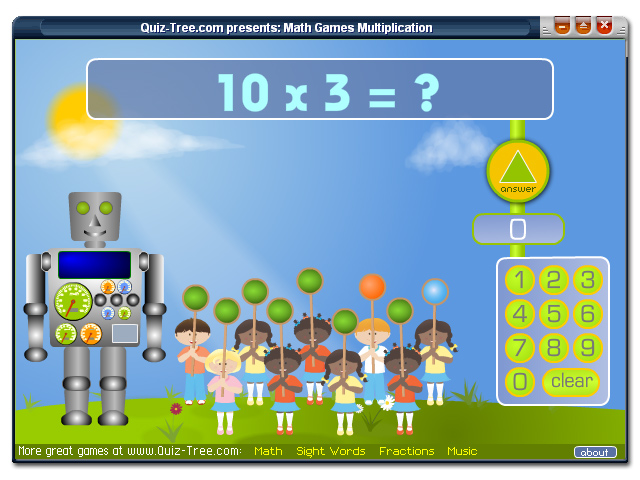
The point is that it would still be fun. If you want to gamify your classroom, start by making the tasks fun, not by hiding the tedium behind flashing lights:
http://www.quiz-tree.com/images/Math-Games-Multiplication.jpg


3. Game mechanics are directly transferable to classrooms

As hinted at above, the central goals of teaching and game design are different; games are there to entertain, teaching is there to encourage learning. Games designers target an individual's attention span, not a class of 30, they have high production values and they do not try to make people do antyhing widely disliked such as maths. Therefore, many of the tools games designers use are just not applicable to teaching. Games can not be blindly copied, but each element should be looked at, adapted or thrown away, depending on its usefulness. Much like Dan Meyer attempts to do, taking elements of good filmmaking, in his 3act math.

4. Gamification means following a set of rules

People often talk about the science of game making; getting the perfect amount and timing of feedback, analysing user interfaces to make them as intuitive as possible, recording millions of data points every second to make a game as addictive as possible, etc. I am currently playing Skyrim. It looks like this:
...See what I mean? Computer games design is just as much an art form as film-making or composing. So while these rules and analysis may be useful, that is certainly not all there is to it and following them would not necessarily make a good game.

5. Classrooms need gamification

This is probably the biggest mistake people have about classroom gamification. The thing is, classrooms are already gamified. In any decent class pupils will:
  • Get timely feedback to know what they have done well and how to improve.
  • Have their achievements recorded.
  • Are rewarded in a variety of ways.
  • Do fun activities which promote engagement.
  • Have the difficulty of tasks adjusted to suit their abilities.
  • Have concrete objectives and rules.
  • Feel no pressure to succeed on the first attempt, but try to learn from any failures.
Now tell me that that is not what gamification tries to achieve!

By the way, Skyrim is completely awesome.

Tuesday, 3 April 2012

Gamification of the Classroom?

It seems that lately I'm hearing about gamification (applying the mechanics of gaming) of everything, including education. My initial reaction was wary, since gaming and education have different core objectives (entertainment and learning respectively). However, reading this article on 'Cognitive Flow: The Psychology of Great Game Design', I couldn't help but think of the similarities between its discussion of feedback and my ideas of what makes good assessment.

This has inspired me to think about gamification and what features of game design it may be useful to apply to teaching. This is just an open thought experiment, so if you have anything to add, or disagree with, please let me know. Note that as well as the article mentioned above, I will also reference "Creating Flow, Motivation & Fun in Learning Games".

Characteristic 1: Games should have concrete goals with manageable rules.


This seems a fairly obvious statement when applied to the classroom. Pupils are generally happier when they know what is expected of them and its why there is so much emphasis from OFSTED about making learning objectives (L.O.s) and outcomes clear throughout the lesson. Ways to achieve this:
  • Make the goals plainly comprehensible in every part of the lesson. This could include linking explanations, questions and assessments to the L.O.s. Particularly useful may be the questions, so that 'if you can do these questions then you have met this L.O.'.
  • Goals and new skills need to be introduced with a minimum of distractions.
  • Time should be taken to train the pupil on new skills in a low risk environment (e.g. when you get the Gravity Gun in Half-Life you first use it to play fetch with dog). Traditionally this is achieved by examples and practice questions. You could also use group activities where pupils can confirm each other's correct answers.
  • 'The completion of small goals (e.g., clearing a field of boars) links to larger goals (e.g., getting enough XP to level up), which in turn link to even larger goals (e.g., getting access to level-specific gear). This linkage creates a series of rewarding experiences that can hook gamers to a game and create the goal-achievement-reward cycle.' This link is certainly present in education; learning skills, connecting with other skills, enabling a higher test score etc., which all links to your final exams. I do think though that this link is not always clear. Sharing standards achieved and how it links to termly reports etc. (see SBG) would be one way of doing this. Another link which I will talk about more below is the link between classwork and 'maths in the real world'.

Characteristic 2: Games should only demand actions that fit within a player's capabilities.


This is obviously desirable, particularly with pupils who lack confidence, but is not always easy to acheive in a class of 30+. Use of optional support and extension tasks can help to find the right difficulty, as can rich tasks, which allow for multiple entry points and investigation. This is similar to the game design idea of Dynamic Difficulty Adjustment.

Other things mentioned are how games should 'avoid introducing a lot of skills at the same time', 'avoid the tendency to over-specify', sticking only to the most important parts, and 'start out simple, with minimal information, and add in new data as needed'.

Characteristic 3: Games should give clear and timely feedback on player performance.


This is what initially caught my attention as a lot of SBG is about creating the opportunity for timely and useful feedback, and in fact people have already discussed its similarities to game systems. Its also what I like about Kate Nowak's Row games, because pupils get almost instant feedback on each question. Its also something that computer apps, such as this excellent algebraic equations app, are capable of achieving.

This section also mentions setting up feedback systems from the start and maintaining them. This is something I've had trouble with in the past and am currently trying to focus on being more consistent with merits, etc.

Characteristic 4: Games should remove any extraneous information that inhibits concentration.

This links to Dan Meyer's discussion of pseudocontext, where he invites you to ask whether the context adds anything to the problem or just disguises it.

Getting people to repeat tasks.


Repetition is obviously conducive to learning, but its sometimes hard to get pupils to perservere when they don't immediately understand. Here are some ways that games can do it:
  • Most games simply let players 'try again' without any stigma attached. This is harder to achieve in a classroom, but it probably starts with encouraging a "growth mindset" culture that embraces initial difficulties, like this 'favourite no' idea.
  • 'Give the player enough feedback so they can figure out how to improve their performance the next time.' This can be achieved through direct instruction and questioning or group/peer work. Its also another stated aim of SBG.
  • 'Allow players to skip excessive and meaningless repetition of the same skill. Focus on skills related to the learning objectives, let the player know when they succeeded, and move on.' Having a harder task that pupils can move on to when they feel they've mastered the basics. Dan's version of SBG has pupils skip problems they already have evidence of mastery with. This is something that I really feel needs improvement in schools. For example, a popular answer to the question 'When Will I Ever Use This????' seems to be that pupils should treat math class like brain training, like how a footballer does weights. However, where is the motivation if you never actually get them to play football? The gaming equivalent would be a computer game that was just one long tutorial. Functional maths tasks and Dan Meyer's 3Acts/WCYDWT problems are a couple of ways to address this. Here, you are applying maths in unmistakably real-world situations. They may be hand picked to be simple enough for pupils to understand, but they do not feel contrived and because they have multiple entry points and solution strategies, they allow pupils to 'play' with the skills they have learned.
  • 'Make the repeated task feel different each time around. This means providing choices, actions, and control so that the player can become engaged in a similar but slightly different experience. Alternately, the next time around, the process should go much faster. This allows them to enjoy the experience of mastery over previously challenging content.' This one has stumped me. Though it sounds entirely applicable to education, I can't really think of ways to do it. Any help on this?

Quick wins from Direct Instruction: Dimensions of Difficulty

This post was inspired by an episode of the Craig Barton podcast with Kris Boulton. Kris was acting as a salesman for Engelmann's Direct...