Showing posts with label maths at work. Show all posts

Thursday, 12 December 2013

Improving Functional Skills in Mathematics

As mentioned in a previous post, I have been thinking lately about how to attack Functional Skills Mathematics to improve results. I have decided on a 4-pronged approach.

Prong 1 - Improving literacy in maths

I have already made a post with ideas and resources for this, which you can find by clicking here.


Prong 2 - Improving problem-solving skills

As functional skills is so focussed on long, involved questions. Students need to feel confortable deciding what steps they need to take and set out their work so that they can follow it and check for mistakes.
  • 3-Act Maths - I find this way of working to be an ideal way to introduce problem-solving to students in a non-threatening way. Starting with just the actual question and no constraints, variables or other information means that problems don't even look mathematical at first and students feel free to take guesses, make assumptions and bring in outside knowledge. Getting students to work out 'the information they would like in order to work out the answer' means that, when you bring those variables in, they are no longer confusing and unclear, but are now the very tools the students were asking for. I've used 3Acts from Dan Meyer's list, problems over at Finding Ways to Nguyen, and picture and video prompts from 101qs. I also sometimes just take a book question, skip all the set-up to the question and just ask the actual question (e.g. How long would it take me to cycle to Edinburgh? Can we get enough rain-water from the college roof to have toilets that run on the recycled water? etc.).
  • Structuring of workings out - e.g. using the problem scaffolder from the previous post on literacy. The idea of this is to help students to think clearly about the steps they are making and what they are trying to calculcate from each step.
  • Discussion of problem-solving strategies - I made some posters last year which I have up on the wall. Before tackling a problem I ask "which strategy could we use here? Why will that help?", when students are stuck I ask "which strategies have you tried? which might you try next?", when they finish I ask "which strategies did you use? did anybody use a different strategy?" Getting students to a point where they're comfortable with using these strategies and are starting to get a feel for when each one is applicable can only help their confidence when faced with a difficult problem.
  • Problem Posing - I originally got this idea from Matt Ives (blog post about it here). Basically the idea is to move focus away from getting the answer and move it on to thinking about the steps you would take and what information you would need. Matt Ives' way of achieving this: don't have any numbers, so pupils can't work out the answer, instead rewarding students who work out the steps they would hypothetically take to find the solution. He has a whole raft of them here on scribd and they've worked very well in the past, once students get away from trying to find an answer.

Prong 3 - Improving mathematical skills

  • Regular lessons - In amongst the literacy and problem-focused lessons, I will also include regular skills lessons. These will come before more complicated problems that involve these skills (along with others) so that students get to see them in context.
  • Starters and Homework - I will also include general basic skill revision in lesson starters and homeworks.
  • Fill in the blanks on calculation tables are a great way to make repetitive practice of a skill more interesting. I wrote a post about it here.

Prong 4 - Putting it together (and improving clear working)

  • Exam questions - The previous prongs will then be put in to practice when we do past-paper questions in class and for homework. I will link the problems to the work we have done on literacy and problem solving and discuss the skills that will be needed to solve the question.
  • 3-Act questions rewritten as past paper questions and vice-versa - After solving a 3-Act problem, I will show a version of how I think it would look like in an exam paper. Hopefully this should make students feel empowered that they've just solved such a difficult-looking question and will help them see the link between the problem-based lessons and the actual exams. After practicing an exam problem I will get students to try to imagine how it would look as a 3-act problem. Not only does this reinforce the link between the two, but help students decide which part is the question, the constraints, the variables, etc.
  • Peer marking - Will help students to see the importance of clear and methodical working as well as to think about different problem-solving strategies that others have used in their working.

Secret prong 5 - Improving Engagement

Overarching all of this is what I feel that I actually do best as a teacher, which is to show students that maths can be enjoyable and engaging. I achieve this in the following ways:
  • Improving accessibility - 3-Act maths are great for this, as are other rich tasks, and the fill-in-the-blanks calculation tables. This is because of the multiple entry points to the questions, and the lack of immediate reading and comprehension required. If students' literacy can be improved, then the more wordy questions will become less and less daunting.
  • Improving confidence - As students get more and more comfortable with multi-step problems they will see that there are things that they can achieve in maths. This never becomes obvious to students who only practice the basic, underlying skills, no matter how good they get at them.
  • Improving relevancy - By this I don't necessarily mean 'real' maths, but I mean maths that students can imagine themselves using in their lives. This is where are a focus on problem-solving strategies can be helpful, because even though the problem itself might not relate strongly to them, being able to use the strategies is applicable by anyone.
  • The strength of my sparkling personality? ...
  

Friday, 6 December 2013

Inspiring Mathematical Applications: Randall Munroe answers all

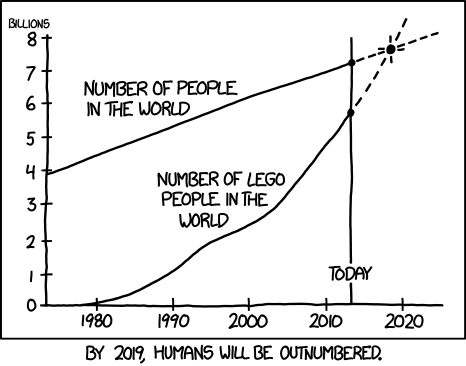
As a Maths teacher, I'm guessing you'll already be familiar with Randall's awesomely nerdy web-comic, xkcd:

Maybe you're also aware of his "What If?" site. If you're not, I'd like to introduce you to it. Each week Randall Munroe, a physicist and former NASA employee, answers question that people post to him online. Though the questions are usually strange ("How fast can you hit a speed bump while driving and live?") and sometimes ridiculous ("If you suddenly began rising steadily at one foot per second, how exactly would you die? Would you freeze or suffocate first? Or something else?"), Randall tries to answer them as accurately as he can, backing up his statements with citations and calculations.

Though, the maths sometimes gets quite complex, the funny topics and humourous pictures combine to make it much more approachable than it otherwise would be.

I love to read them just for myself, but I've also started bringing them in to some of my classes. Last week I found lots of ideas and resources for improving literacy in maths. This week, one of the ideas I tried was about scaffolding the problem, specifically splitting a question in to its important parts (The actual question, the information given, the constraints, what calculations are needed, etc.). As a plenary I asked them to guess the answer to, "Is it possible to build a jetpack using downward firing machine guns?", then to read through the What If? article about it, whilst highlighting the different components of the text (The question, the information gathered from research, the calculations, the constraints, etc.).

It worked very well, and the students really saw the link between the work they'd just done and the work done in the article. I'm hoping that this link will help them to feel empowered (because the techniques they are using work on much more complicated questions) rather than disenchanted by the complexity of the maths.

Monday, 11 November 2013

How to create enagaging, functional maths problems in 2 minutes *UPDATED


Step 1: Take a table of calculations that have already been done:

e.g. Bills, receipts, timetables, answer keys to textbook functional maths tasks.
or


Step 2: Progressively blank out more and more information:

Here the aim is to create questions that get harder as you work down the page. Often that means either blanking out more of the boxes or blanking out the initial boxes from which the calculations are made (creating a reverse, "here's the answer, what's the question?", problem).
or


Step 3: Profit?

For some reason, my pupils really seem to enjoy these. One possible reason for this is that it makes any random table in to a kind of logic puzzle. Mainly though, I think my functional maths groups get a bit sick of your standard functional maths problem, which looks like this:


Lots of good, and relevant, Maths here, but its terrifyingly wordy, there are so many constraints thrown at you at once, and you have to keep flipping between the question, your working and a data-sheet.

Blanking out a table can't replace these types of questions, as this is exactly the type of question that they will be tested on in their functional maths exams, but it is a good way to introduce a complicated set of calculations in a non-threatening way. The further constraints and wordy questions can be introduced later.


Optional extras:

  • Before you show the table, get pupils to think about what its going to contain/what calculations will be done (e.g. "If you were trying to work out how much you'll be getting paid at the end of the month, what pieces of information are important? If you knew these things, what calculations would you do?").
  • Use this as an intro, to get pupils accustomed to the table and calculations involved, then bring in the wordy questions as a follow-up.
  • Get the pupils to come up with the constraints for the more complex problems (e.g. "Write a list of steps to take for getting up and taking the bus to school. How much does each one take (roughly)? When do you want to get in to school? Which bus should you take?")
    (instead of this question)
  • Involve pupils in the process - I haven't tried this one yet, but it could be done when they have completed a more textbooky problem. Get them to tipex over some of the numbers in their calculations in order to create a problem set (as in steps 1 and 2 above), then swap books with their neighbour and try to fill in the tipexed blanks.

*UPDATE - Here's another pre-made  problem on probability and percentages:


Friday, 4 October 2013

Inspiring Mathematical Applications: Cheating at Pool

Apparently, this is a Portugese project which uses a camera above the pool table to detect the positions of the balls and cue.

And here is an explanation of how it works (us non-Portugese speakers can turn on English captions):

Monday, 16 September 2013

Inspiring Mathematical Applications: Cage-Fighting (which should really be called MMA).

The amount to which Mathematics can be applied to almost any real-world phenomena is simply astonishing (which is not exactly the same as saying is SHOULD be applied to everything). Most students don't ever see this. Most adults never see this. One of my favourite reactions when I do a #3Act lesson is "Why are we watching this, sir? This isn't Maths", because I know that they'll be happily modelling the situation in the next 5 minutes.

Anyway, I also like to bring in unexpected, interesting uses of Maths as a sort of show and tell in some of my classes and I thought that I'd share some of them on my blog.

To kick off, we're starting with my favourite sport: MMA, and one trainer in particular's use of basic game theory to plan out fights. Original Article.

Nodes
Every fight starts off with both fighters standing just out of striking range. We can call this the initial node. From there, a fighter can move in with a punch, a kick or by trying to grab hold of the other for a clinch or take-down. After each move you end up in a different position or node. Each of those moves lead to a different set of optional follow-up moves and fighters can chain together as many of these moves as possible, traveling from node to node. You can visualize this in a diagram. The nodes are circles with the edges being the moves to get there:


Greg Jackson uses these diagrams and adds success probabilities to each edge using data he collects by watching previous fights and sparring sessions. From there you can calculate the optimal nodes to aim at in order to allow for the highest probability of success later on. You can also block off the routes that lead to your opponent's strongest nodes to 'take them out of their A game'.

More data is used from an MMA data collection website: FightMetric


Monday, 13 August 2012

Lesson Sketch: mathematics of a cake sale

Intro:

There is a cake sale coming up and you plan to sell these flapjacks:
http://allrecipes.co.uk/recipe/3846/apricot-oat-flapjacks.aspx
How much should you charge for one? Why? Will that make me a profit? How do you know? How much profit would I make? How could I work it out?

Main:

Give pupils the recipe: http://allrecipes.co.uk/recipe/3846/apricot-oat-flapjacks.aspx and either a table of prices or access to a supermarket website, such as http://www.tesco.com/
Pupils work out how much it costs to make a batch of 8 flapjacks and the profit they could make on each one sold.

Extension:

What are the most expensive parts of these flapjacks? Try to replace some things in the recipe with something similar in order to make the total cost lower. How much profit would you make now? How cheap could you make them?
Can you find a different cake recipe that would be cheaper to make?

Further Discussions:

This cake is slightly cheaper to make than the flapjacks:
http://allrecipes.co.uk/recipe/23758/rich-tea-biscuit-cake.aspx
Should I make these instead of the flapjacks? Why? Why not? What other considerations should I be making apart from price? (Time, effort, equipment needed, etc.)

You may discuss how some people factor time as money using a basic wage.

Friday, 17 February 2012

Good Problems: My rubric

In my last post I mentioned my plan to make arhcaeology based maths lessons. In doing so I tried to create a rubric to make it clearer in my mind what I was trying to achieve. Now that I have the at least the skeleton of my series of lessons, I felt it would be important to revisit these and I'm sharing them here mostly just to remind myself what I wrote.

Good problems should be:
  • Realistic: Not contrived. Should be a problem that someone in the profession might actually face and solve using a similar method to ours.
  • Intuitive: Have multiple entry points and opportunities for students to use their prior knowledge on the problem.
  • Visual: Multimedia used to give context of profession and add believability.
  • Extendable: Has follow-up problems and ideas for further reseach for those interested.
  • Vital: Mathematical skills used are necessary for the problem.
  • 1st Act: Problem should be able to be introduced in a viceral way, with no maths involved.
Other desirable properties:
  • Unexpected: An area that pupils would not think is particularly mathematical.
  • Personalisable: Problem can incorporate data from a company or organisation.

Lesson Sketch: Archaeological Classification

I'm currently in the process of making a series of lessons based on archaeology. Its been really hard going and I'm only marginally happy with the results. I'd really love some feedback about a lesson, which I'll post below. How can it be improved? How can I get across the lesson activities more concisely? Is there any way I could make the lesson activities more intuitive to students?


Lesson Plan – Classification


Background information:
The question of classification of finds is a very important one in the study of Archaeology. Pottery, for example, can be classified in terms of type of vessel, date of manufacture, place of manufacture, and style. For these classifications to be meaningful for analysis they must be reliable and consistent, so that different Archaeologists would classify objects in the same way. One of the simpler ways to do this is to give inequalities in terms of measurable properties of the pieces (e.g. Diameter of base).
Objectives:
  • Pupils define inequalities that distinguish between the different types of pottery.
  • Pupils use these inequalities to see what type of pottery an artefact is.
Duration:
1 hour
Prior Knowledge:
Cartesian co-ordinates, equation of a straight line
National Curriculum Links:
  • 3.1e Linear, quadratic and other expressions and equations: They solve inequalities in two variables
  • 3.1e Linear, quadratic and other expressions and equations: They use algebraic and graphical methods to solve simultaneous linear equations in two variables.
Level:
8

7

Keywords:
  • Classification
  • Pottery
  • Inequality
  • Consistency
Resources:
  • Classification – Resources
Equipment needed:
·         Projector or interactive whiteboard
·         Rulers
Times:
20 minutes
Introduction:
  • Give out copies of the examples of different ancient pottery (resource no. 1)
  • Pupils work in pairs assigning one of the four types: Plate, Bowl, Pot, Urn to each piece of pottery.
  • Display the examples of different ancient pottery on the projector. Go through the pieces, recording and discussing any disagreements.
  • Ask the students to imagine that they are archaeologists working on different sites and we would like to compare the finds on each site.
Ø  What problems would arise from disagreements about the different sorts of pottery? How could we solve them? What properties does a plate have?
25-30 minutes
Main Activity:
  • Explain that if we can describe a type of pottery by things we can measure about it, like height, then we could consistently classify objects.
Ø  What properties could we measure with this pottery?
  • Display the heights of known pottery types (resource no. 2) and the rim diameter of known pottery types (resource no. 3)
Ø  Can we say anything in general about the heights/rim diameters of plates/urns? Why is this not enough to define what makes a plate?
  • Display the graph of heights vs. rim diameter (resource no. 4). Explain that we are now looking at both properties at once.
Ø  Is it now possible to draw a line to separate any of the pottery types from the others?
  • Invite a pupil to draw this line on the board. Go through the steps needed to draw this as an inequality. Show how to shade in the unwanted side.
Ø  What are the properties of the objects in the wanted region? Is this reasonable for a plate?
  • Hand out the graphs of heights vs. base diameter and base diameter vs. rim diameter (resources 5 and 6). Explain that we can use these graphs to separate pots and urns from the others, but we may need more than one inequality.
  • Pupils find these inequalities.
Ø  What are the properties of the objects in the wanted region? Is this reasonable for a pot urn? How can we tell if something is a bowl?
10-15 minutes
Plenary:
  • Go through the pottery finds slides (resource no. 7). First show the estimated dimensions of the artefact. Show the artefact once pupils have decided what type of pottery it belongs in.
Ø  What type of pottery is this? How did you work it out?
Differentiation, extension material and further reading:
Ø  How would you change the inequality to describe all the pottery that is not a plate? What happens if an artefact lands exactly on the line?
Ø  How can we deal with disagreements about which line to draw? Does a ‘best line’ exist? Could we define rules to draw this ‘best line’?
Links to other subjects:
  • Plant classification
Other Comments:

  •  


Quick wins from Direct Instruction: Dimensions of Difficulty

This post was inspired by an episode of the Craig Barton podcast with Kris Boulton. Kris was acting as a salesman for Engelmann's Direct...