Showing posts with label inquiry. Show all posts

Sunday, 3 March 2013

Lesson Sketch: Who Wrote This?

I'm excited about this lesson idea! So excited that it had me tweeting J.K. Rowling and Stephen Fry (though I didn't get a reply yet from either). I hope you like it as much as my pupils did last week.

Act 1

Get pupils to read this letter:

Dear ___________,
I'm so sorry to hear that life is getting you down at the moment. Goodness knows, it can be so tough when nothing seems to fit and little seems to be fulfilling. I'm not sure there's any specific advice I can give that will help bring life back its savour. Although they mean well, it's sometimes quite galling to be reminded how much people love you when you don't love yourself that much. I've found that it's of some help to think of one's moods and feelings about the world as being similar to weather:
Here are some obvious things about the weather:

It's real.
You can't change it by wishing it away.
If it's dark and rainy it really is dark and rainy and you can't alter it.
It might be dark and rainy for two weeks in a row.

BUT

It will be sunny one day.
It isn't under one's control as to when the sun comes out, but come out it will.
One day.

It really is the same with one's moods, I think. The wrong approach is to believe that they are illusions. They are real. Depression, anxiety, listlessness - these are as real as the weather - AND EQUALLY NOT UNDER ONE'S CONTROL. Not one's fault.

BUT

They will pass: they really will.
In the same way that one has to accept the weather, so one has to accept how one feels about life sometimes. "Today's a crap day," is a perfectly realistic approach. It's all about finding a kind of mental umbrella. "Hey-ho, it's raining inside: it isn't my fault and there's nothing I can do about it, but sit it out. But the sun may well come out tomorrow and when it does, I shall take full advantage."
I don't know if any of that is of any use: it may not seem it, and if so, I'm sorry. I just thought I'd drop you a line to wish you well in your search to find a little more pleasure and purpose in life.

Very best wishes, ____________
Tell them that it was written by one of the following people:
J.K. Rowling Lewis Carroll Stephen Fry
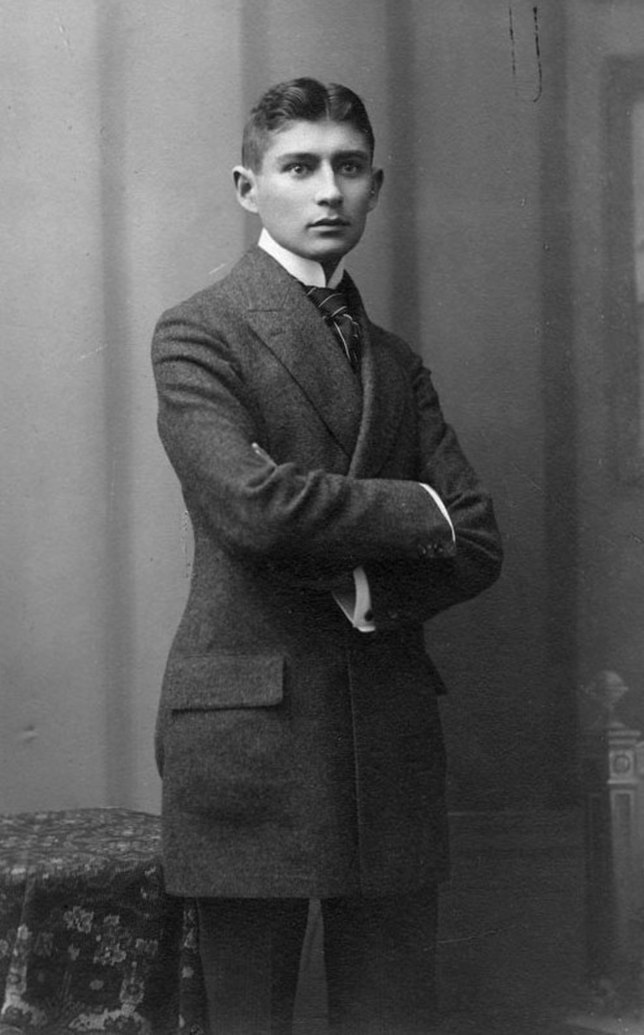
Russell Brand Franz Kafka Fyodor Dostoevsky

Let them discuss who they think it might be and why. Ask if there are any we could discount straight away. (note: I feel that I should have more women up there. Can you think of any women authors that all the kids would know?)
They will talk about writing styles and uses of certain words and things they know about the lives of these authors (I've purposefully used people for whom it would be understandable that they would have written such a letter).

Act 2

We are going to try to use their writing styles to determine who wrote it. What sort of things could we measure about their writing styles? (Some) Possible answers:
  • How often they use certain words/punctuation marks (make sure the words chosen are common enough to be in other writings and not specific to the context).
  • Average sentence length.
  • Average paragraph length.
We will also need some samples to measure these things on. I'd use the previews you can get on Google Books:
This task works best if each group measures and compares a different word or aspect of the writing as it creates for some great discussions about which measurements hold more weight and why.

Act 3

Write a table of the techniques each group used and the conclusion they made from it. Decide as a group who we think it is. By this point my students were desperate to know who wrote it. Talking points:
  • Accuracy and how we could have obtained better estimates.
  • Which techniques should hold most weight? Why?
  • Why is "The Beadle and the Bard" probably not as useful to use as "The Fry Chronicles"?
  • Where might this technique be used outside the classroom?
Reveal the answer: Tadaa!
After this you might also want to show how historians have used this exact same technique (and its name: Stylometry)!

Final Notes: When I used this in class, with student written essays rather than a famous letter, it worked exceptionally well. As I said, pupils were desperate to know who wrote the essay by the end. It fell down a little at the end as I didn't have a good way to show the answer. Making it about celebrities (I think) makes the answer more interesting.
The reason I tweeted Fry and Rowling was to try to get a school essay from them (the story would be that I have an old school essay from a celebrity and I could sell it if only I could remember which of these people had written it). This letter works well and is a great and interesting bit of writing in itself. The only problem I have with it is that students could quite easily Google part of the text and get the answer.

What about you? How could you improve it?

Sunday, 3 February 2013

16% Time Revised: Scaling it back

Hi there. Been a while hasn't it? Well I'm back baby!

I'm now on my second term of the 16% time experiment, and I've made a few minor changes. There were two big problems with my first attempt; we didn't have time (only 3 or 4 hours per term) to really get in to some of the more impressive sounding projects I (or they) suggested and many pupils had no idea how to start answering some of the questions posed. This is a top-set group and yet I repeatedly had to suggest googling a maths word they didn't yet know!

I still think that these big projects are within their grasp, but I think we started too big and students who have not done anything like this before just got lost.

Scaling it back
  • Project suggestions are now reasonably 'completable' in 1-2 hours.
  • They come with minor prompts and questions, to scaffold the directions they could take.
  • There is a difficulty rating on each project.
  • If they want to do a different project, I have a form for them to work through that gets them to write their own criteria for success and scaffold the project themselves.

We've had one lesson in this style and it was a lot more purposeful an environment and more accessible to the lower end of the class. I'm not sure if this will be quite as inspiring as before though. I'll let you know how it goes.

Here are my new suggested projects so far:
Revision  Complex Numbers  Arithmetic Proofs  Euclid  Different bases  Estimation and Large Numbers  Magic

Monday, 29 October 2012

16.6666666666% Time

I have some very bright and very highly motivated pupils in my top-set year 10 class this year and I feel like my classes are a bit wasted on them. The topics we go through need to be practiced and there is always extension material for them, but they just breeze through it. Last week I completely failed at tried to create a 3D-Graph, following this excellent post by Ashli. Basically I botched the explanation and expected too much to get done in a single lesson. Anyway, it was motivating to some, but others just felt it was another standard maths lesson.

Inspired by Shawn Cornally's Inquiry style of teaching and the idea I first heard from Google of 20% Time for employees, I decided to try out our own version of 20% Time in class:

In a recent survey I did with the pupils, most were happy with the pace of our classes, about 6 felt it was too slow and a couple felt it was too fast. I didn't want to leave that majority out of this, which is why I give them the option to revise topics. I will provide materials for this and it should hopefully help those less confident students.
To start with, my guess is that pupils will not have any idea where to go with this, so I have a few suggested project ideas:

Though I'm dangling these in front of them in the hope that someone will bite, I made it clear that they can really choose any topic they want. There are only two constraints:
  • It must be mathematical and include maths which is currently beyond their knowledge/ability.
  • Success or failure in the project is not so important, but you must aim for the project to be awesome (no powerpoints based heavily on wikipedia, etc. I want outrageous 6ft models and flashing, dancing lights!)

When they have picked a project and started working on it, I will drop a few words like 'game theory' as hints to the directions they could go, and vet their projects for mathematical content and awesomeness. Apart from that though, I hope to sit back and let them explore.

What do you reckon? Do you have any other intriguing/inspiring project ideas I could offer up as bait?

Friday, 17 February 2012

Learning how to teach

I've recently discovered this website, Bowland Maths, which not only has some great resources and ideas for inquiry-style learning, but also has some professional development modules to help you get to grips with teaching in this way.

 I've only done the first development module so far, but i found it very useful and practical. It encourages you to actually try a lesson out (about a school in honduras made from plastic bottles) whilst guiding you through its analysis. Give it a go.

Quick wins from Direct Instruction: Dimensions of Difficulty

This post was inspired by an episode of the Craig Barton podcast with Kris Boulton. Kris was acting as a salesman for Engelmann's Direct...